Lies
I grew up on my mother’s lies
offered up at every need.
Her need, not mine.
To her credit,
adults routinely,
habitually,
without compunction
lied to children when I was young.
Any topic which made them uneasy—
sex, bodily functions, finances, birth, death …
sex—
all to be kept from children’s tender ears.
Such offending topics
either buried beneath silence
or presented as outright,
bald,
in-your-face
lies.
My mother good at both.
Perhaps better than most.
For example …
I never met my uncle Kenny.
He entered my life
only through the photo
my aunt Carol set up on the old dresser
in the corner of the kitchen
when she came to visit.
My aunt, resplendent in her SPAR uniform.
He, handsome in uniform, too.
Both, glamorous in my small world.
Then came the day my aunt visited
without the uniform,
without the photo,
but with a baby.
Enchanted by the baby,
I missed neither uniform nor photo.
Yet more visits passed.
The baby grew.
And the photo never appeared again.
One day, plucking the memory
out of an enshrouding mist,
I asked my mother,
“Didn’t there used to be an uncle Kenny?”
“No,” my mother said.
Simply. Flatly,
“No.”
No explanation, of course,
about the origins of my baby cousin.
I didn’t ask again,
merely twisted my brain
this way and that
trying to account
for my memory
of that photo
called “Uncle Kenny.”
Another story of the same ilk.
Dr. Slater,
family doctor and godfather,
was to be admired.
My mother said so.
All that education!
But I found him gruff, scary.
His wife, however, his office nurse,
was cheer itself.
While Dr. Slater grumphed over me,
addressing himself to my mother,
Mrs. Slater, young and pretty,
looked right at me,
talking to me
in a bright falsetto.
I thought the falsetto odd,
but loved the unaccustomed light
of adult attention.
I remember Mrs. Slater most clearly
the day I broke my arm,
tumbling from the back
of a rambunctious horsey,
my brother, the horsey.
When Dr. Slater gave a sharp tug
to set the bone,
I howled.
Mrs. Slater,
resplendent in her white nurse’s uniform,
picked up my velvet bonnet
and put it on.
“Look at me!” she cried. “Look!”
I looked at her silly smile
framed by that ridiculous bonnet
and cried harder.
Not long after,
she disappeared from the office,
disappeared and didn’t return.
And one day,
remembering the attention,
the falsetto voice,
the bonnet,
I asked my mother,
“Didn’t Dr. Slater used to have a nurse?
And wasn’t she his wife?”
My mother answered,
simply and flatly,
“No.”
And since it never occurred to me
that she might be lying—
could grown-ups even do that?—
I was left to struggle with my distinct memory
of a woman in a child’s velvet bonnet,
of a uniformed man in a photograph,
neither of whom had ever existed.
All so my mother could avoid using the word divorce.
Thus I emerged into adulthood as a fierce truth-teller,
especially when speaking to children.
Even when my three-year-old son asked,
on Christmas morning,
“Mommy, did Santa Claus really tiptoe into my room
and put those things in my stocking
or did you do it?”
I couldn’t find the gentlest lie in my heart.
I talked of Santa as the spirit of giving.
I talked about stories as truth.
But I answered his question.
“I did it,” I said.
And that was all he wanted to know.
In that moment,
his baby sister lost the mystery,
the thrill of the Santa Claus game.
As soon she was old enough to understand,
her brother was at her side,
handing out the facts
his mother had given
into his possession.
“That’s the worst thing you ever did as a parent,”
she accused me, once, years later.
I understood,
of course.
I only wish
my artless truth-telling had, indeed,
been the worst thing.
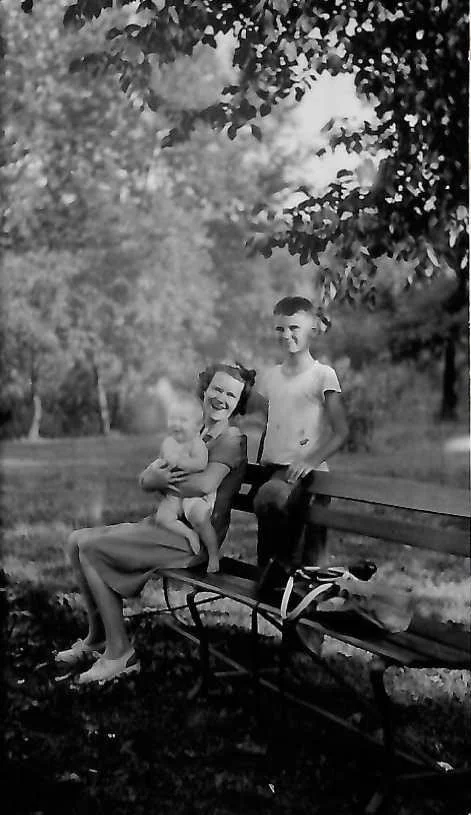
Aunt Carol with Cousin Christy and Willis
